
- Teacher: Febin Muhammed .
ACAS Wandoor
Skip available courses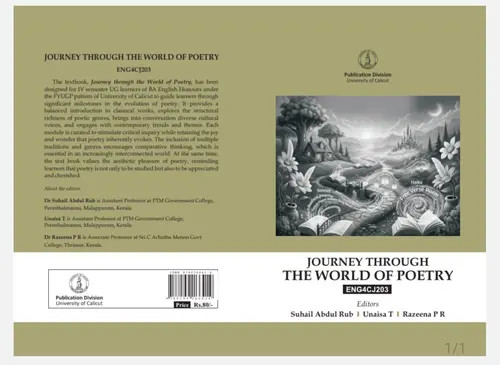
Available courses
The course aim to explore key ideas of lasting value in the history of economic theory
- Teacher: AnjuThrishna .
This course introduces students about statistical methods for economic
analysis. Students shall acquire in-depth knowledge in the concepts of
probability, probability distributions, theory of estimation, hypothesis
testing and their applications in economic analysis.
- Teacher: Dr. Sanitha VP .
The course covers a broad spectrum of topics aimed at understanding the framework, challenges, and implementation of human rights in the indian context. A detailed study of the Indian Constitution, focuses on fundamental rights, the role of the judiciary, and the directives for the state to ensure human rights.
- Teacher: Laseen Farhan K .
This course deals with the basic and important knowledge abut the rules of the
composition and dictionThis course deals with the basic and important
- Teacher: ABDUL JABBAR T Arabic
This course provides a comprehensive understanding of literary criticism by exploring diverse theoretical perspectives from antiquity to modern times. Learners will delve into pivotal works by influential thinkers, gaining insights into various critical lenses used to analyze literature. Through interactive discussions and activities, learners will enhance their ability to analyze literature from multiple perspectives. The course concludes with a collaborative project where learners apply their acquired knowledge to analyze specific literary works using chosen critical approaches. Upon completion, learners will possess refined analytical skills and a deeper appreciation for the complexities of literature and criticism.
This course provides a comprehensive overview of data science, covering the
various types of data and their applications.
The students will acquire a deep understanding of exploratory data analysis
along with hands-on implementation skills. . The curriculum introduces both
supervised and unsupervised and techniques of Machine learning.
Additionally, the data pre-processing techniques are introduced Overall, the
course provides a comprehensive understanding of the fundamental data
science principles, guiding students through the data science process and
illustrating practical applications.
- Teacher: JASMINE MT .
ഭാഷയും മാനവിക വിഷയങ്ങളും പഠിക്കുന്ന വിദ്യാർത്ഥികളുടെ
സാഹിത്യാസ്വാദനശേഷി വർധിപ്പിക്കുക എന്നതായിരുന്നു ഒന്നാം
സെമസ്റ്ററിലെ എബിലിറ്റി എൻഹാൻസ്മെന്റ്കോഴ്സ്
ലക്ഷ്യമാക്കിയത്.അതിന്തുടർച്ചയായി അപഗ്രഥനം, വിമർശനം,
വിവർത്തനം, രചന എന്നീ ഭാഷാശേഷികൾ ആർജ്ജിക്കാനും ഭാഷാ
മാനവികവിഷയങ്ങളുമായി ബന്ധപ്പെട്ട വിവിധ സന്ദർഭങ്ങളിൽ
പ്രയോഗിക്കാനും സാധിക്കുന്ന രീതിയിലാണ് ഈ സെമസ്റ്ററിലെ
കോഴ്സ്രൂപകല്പന ചെയ്തിരിക്കുന്നത്.
- Teacher: Dr. SANIL A S .
This course offers a comprehensive understanding of cross-cultural fictional
narratives and its adaptations around the globe. The course will offer the
opportunity to the students to engage with works from variety of genres,
including short stories, novels, and experimental fiction. Special attention will be
given to socio-cultural contexts in which these works were written, allowing
students to appreciate the diversity of voices and perspectives that fiction offers.
- Teacher: Farheena Hiba C .
This course aims to equip students with practical skills in applying cost
accounting concepts to real-world business situations. Various applied
cost accounting techniques such as job costing, batch costing, process
costing and standard costing etc are included.
- Teacher: VIJISHMA AYYADAN .
This course aims provide an overall understanding of the movements in the Indian freedom struggle from 1916-1947,popularly described in the history text books as Gandhian phase of Indian national movement. After completing this course students will be able to understand how Gandhian method of struggle changed the base of Indian national movement and how it became a popular movement
- Teacher: Saritha P .
The course aims to understand the concept of gender and its trajectories across
literature and popular culture.
- Teacher: ABDUL NASIR VELLARAMPARA .
The paper Basics of Communication introduces undergraduate students to the fundamental principles, processes, and practices of communication in personal, academic, and professional contexts. It examines communication as a dynamic and interactive process involving sender, message, medium, receiver, feedback, and context, while also addressing the barriers that influence effective communication. The paper emphasizes the role of verbal, non-verbal, and written communication in shaping meaning and understanding.
Students are exposed to key concepts such as intrapersonal, interpersonal, group, and mass communication, along with an introduction to media and digital communication in contemporary society. Through theoretical insights and practical activities, the paper develops essential communicative competencies, including listening, speaking, reading, and writing skills. It also encourages reflective thinking by enabling learners to analyze their own communication experiences and improve self-expression.
Overall, Basics of Communication aims to build a strong foundation in communication literacy, fostering confidence, critical awareness, and ethical responsibility. The paper prepares students for advanced studies in media and communication-related disciplines while equipping them with lifelong skills necessary for effective participation in social, cultural, and professional environments.
- Teacher: Bijina K ,Department of Journalism
This course explores important concepts, basic theories and models and
other fundamental macro aspects of economics
- Teacher: AnjuThrishna .
This course aims to equip students with a comprehensive understanding
of the legal and regulatory environment in which corporations operate.
- Teacher: Maneesha V COMMERCE
This course offers a comprehensive examination of various literary expressions
interweaving the past and present. Through a combination of classic and
contemporary works, as well as engaging TED Talks, speeches, illustrative
narratives, web series and films, students will delve into the rich tapestry of
human expressions through literature.
- Teacher: NASEERA MK Department of English
This course provides a comprehensive understanding of literary
criticism by exploring diverse theoretical perspectives from antiquity to
modern times. Learners will delve into pivotal works by influential
thinkers, gaining insights into various critical lenses used to analyze
literature. Through interactive discussions and activities, learners will
enhance their ability to analyze literature from multiple perspectives.
The course concludes with a collaborative project where learners apply
their acquired knowledge to analyze specific literary works using chosen
critical approaches. Upon completion, learners will possess refined
analytical skills and a deeper appreciation for the complexities of
literature and criticism.
- Teacher: JAHANA P .
This course explores important concepts, documents and other fundamental
aspects of budget process with reference to Central Budget in India.
- Teacher: Dr. Pramod K M KM
This course aims to deepen learners understanding and appreciation of
poetry as a literary form. Through close reading, analysis, and
discussion of various poetic works, students will explore the
multifaceted dimensions of poetry, including its aesthetic, emotional,
and intellectual elements. The course will cover a range of poetic styles,
genres, cultures, trends and themes, enabling students with the tools to
critically engage with poetry and to articulate their interpretations
effectively
- Teacher: Mr. Midhulaj. P .
To continue to study Economics in semesters 7 and 8, batch B1(A2) needs to earn additional 15
credits in Economics to make the total credits of 68. Suppose this condition is achieved, and the
student of batch B1(A2) proceeds to the next semesters to study Economics. The course
structure in semesters 7 and 8 is the same as for pathways 1 – 4, except that the number of the
core and elective courses is in continuation of the number of courses in the two categories
completed at the end of semester 6, taking into account the number of courses in Economics
taken online to earn the additional 15 credits
- Teacher: Imen Muhammad M K .
This course is a quick review of linear algebra, intended for students who have
already taken a previous course in linear algebra or have some experience with
vectors and matrices. It begins with the concepts of vector spaces, subspaces, bases and dimension. Linear transformations are introduced as 'natural maps' between vector spaces. The course opens up the classical finite dimensional inner product theory for the canonical reduction of a matrix as a special case of a self-adjoint operator.
- Teacher: Ms. SHARSHAD AMEERA U .
This course aims to develop students with a strong foundation in
business statistics and the ability to apply statistical techniques to solve
practical business problems. Various statistical tool such as correlation,
regression, set theory, theoretical distribution are covered under this study.
- Teacher: Ms. DHANYA M .
This course aims to empower students with knowledge and skills needed
to promote healthy living and prevent lifestyle diseases through
informed choices in nutrition and physical activity.
- Teacher: Sanil PP .
Students will acquire a comprehensive understanding of key
statistical concepts; random variable, standard theoretical
distributions and sampling distributions.
- Teacher: Hima KC Staff
This course provides an introduction to microprocessors and microcontrollers, focusing on the 8085 and 8051 architectures. Students will gain an understanding of microprocessor/microcontroller architecture, instruction sets, programming, and interfacing with peripheral devices. The course includes both theoretical and practical components.
- Teacher: Test Staff
In the first part of the course, it intends to give a quick introduction to writing
python programs using various popular interfaces. How to handle data and save and read them files is introduced next along with the concepts of repeating the tasks using conditionals and loops. The problems connected with matrices and arrays is solved using the python module numpy. The python module SymPy is used to do various mathematical problems related with symbolic computations.A brief introduction of python module pandas is given, which is used to do data analysis. Using the Python programming structure, an introduction to the advance mathematics software sagemath is given in the second part of the course. Various practical problems making use of concepts from the calculus and linear algebra are to be solved using the sagemath software so that the students will come to know some of the applications of mathematics in real life.
- Teacher: Shifna Sulthana.K Staff
This course provides an in-depth analysis of monetary policy and its role
in stabilization within the framework of macroeconomic theory. It
examines the tools, objectives, and implementation of monetary policy,
and its effectiveness in achieving macroeconomic stability. The course
also explores the relationship between monetary policy and other
macroeconomic variables such as inflation, output, employment, and
economic growth.
- Teacher: Dr. Sanitha VP .
This course aims to enhance communicative abilities through advanced
LSRW skills. It is designed to develop learners’ language proficiency by
honing their abilities in effective communication, critical thinking and
analysis, persuasive and creative expressions and interpersonal
interaction in personal and professional settings.
- Teacher: Drisya Krishna V T English
The course provides a comprehensive exploration of integral calculus, covering
techniques such as indefinite integrals, Riemann sums, definite integrals,
properties of integrals, the Fundamental Theorem, L'Hopital's Rule, basic
integration formulas, and applications in finding areas between curves, volumes
of solids, lengths of plane curves, and areas of surfaces of revolution. Through
these topics, students gain proficiency in solving a wide range of mathematical
problems involving integration and its applications in various fields
- Teacher: Admin User